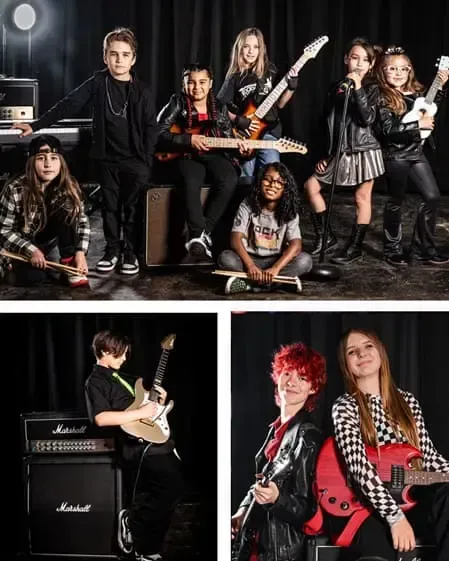
How Music Lessons Help Kids Develop Focus and Discipline
How Music Lessons Help Kids Develop Focus and Discipline
Parents want activities that are fun for their children, but it's even better when those activities help develop skills they can use throughout life.
Music lessons offer kids the opportunity to do both.
Learning an instrument requires students to listen, practice, solve problems, work through challenges, and gradually improve. Along the way, kids can develop habits involving focus, patience, responsibility, and self-discipline.
At Rockstars of Tomorrow Greenwood, we see these skills develop one lesson, one song, and one accomplishment at a time.
1. Music Teaches Kids to Focus on One Thing at a Time
Learning music requires attention.
A student might need to listen carefully to an instructor, follow a rhythm, remember a chord change, read music, or concentrate on a specific section of a song.
For beginners, even playing a few measures correctly can require considerable focus.
As students progress, they learn how to break larger challenges into smaller, manageable pieces and concentrate on improving them one at a time.
That's a valuable skill both in music and everyday life.
2. Practice Creates a Routine
Becoming a better musician requires consistency.
That doesn't mean a child needs to spend hours practicing every day. Especially for beginners, shorter and more focused practice sessions can be much more approachable.
The important part is developing a routine.
Setting aside regular time to pick up an instrument and work toward a goal helps children experience the connection between consistent effort and improvement.
Over time, practice becomes less about being told what to do and more about taking responsibility for their own progress.
3. Kids Learn That Progress Takes Time
We're surrounded by instant results. Learning an instrument works differently.
A difficult song may take days or weeks to learn. A chord might not sound right the first time. A rhythm may require repeated practice before everything finally clicks.
Music gives kids opportunities to experience something incredibly important:
You don't have to be good at something immediately to eventually become good at it.
Students learn to work through frustration, make adjustments, and keep trying.
When they finally play something they once thought was impossible, they get to experience the result of their own persistence.
4. Music Gives Kids Clear Goals
Music provides natural milestones.
For a beginning student, the goal might be learning their first chord or playing their first complete song.
As they progress, those goals can become bigger:
Learning a favorite song
Mastering a difficult section
Performing at a student showcase
Auditioning for a musical
Joining a band
Writing an original song
Recording music
Having something specific to work toward gives practice a purpose.
Instead of simply being told to "practice," students understand what they're trying to accomplish.
5. Mistakes Become Part of Learning
Every musician makes mistakes.
Wrong notes happen. Singers miss pitches. Drummers lose the beat. Guitarists forget chord changes.
Music lessons give children a safe place to make those mistakes and learn what to do next.
Instead of treating a mistake as failure, an instructor can help the student identify what happened, slow things down, try a different approach, and work through the problem.
That process encourages patience and problem-solving while teaching students that mistakes are a normal part of learning something new.
6. Performing Creates Accountability
There's something different about practicing when you know you're preparing for a performance.
A showcase, recital, audition, or band performance gives students a real reason to prepare.
They begin to understand that their preparation matters, especially when other musicians are depending on them.
For students who play in bands, that responsibility becomes even more noticeable. Learning your part isn't only about your own performance. The rest of the band is counting on you.
That creates a natural lesson in preparation, teamwork, and accountability.
7. Kids Get to See Their Own Progress
One of the best parts of learning music is being able to recognize how far you've come.
The song that seemed impossible three months ago becomes something you can play without thinking about it.
The student who was nervous about performing eventually walks onto the stage with confidence.
Those moments matter.
They show children that improvement isn't always immediate, but consistent effort can produce real results.
More Than Learning an Instrument
We want our students to become better musicians, but the experience of learning music can offer much more.
Every lesson gives students opportunities to practice:
Focus
Patience
Responsibility
Goal setting
Problem-solving
Persistence
Teamwork
Preparation
Those skills aren't taught through a lecture. They're developed naturally as students work toward something they genuinely want to accomplish.
And that's one of the things that makes music such a powerful learning experience.
Help Your Child Discover Music
Your child doesn't need musical experience to get started.
At Rockstars of Tomorrow Greenwood, we offer private music lessons for beginners and experienced students in guitar, piano, drums, voice, bass, violin, and more. Our instructors meet students where they are and help them progress at a pace that keeps them challenged and excited about learning.
And as students grow, they can take their music beyond the lesson room through bands and live performance opportunities.
The best way to find out if music lessons are right for your child is to experience one.
Schedule a Free First Lesson at Rockstars of Tomorrow Greenwood and give your child the opportunity to discover what they can accomplish through music


